
Day trip from Chefchaouen
Akchour Waterfalls & God's Bridge
Two very different walks start from the same car park 30 km above Chefchaouen, and picking the wrong one is how people end up disappointed. This is what is actually there, how long each trail really takes, and the months the big waterfall is a trickle.
A private driver takes you out and waits while you walk. From €55 per vehicle, cash to the driver.
Last updated: Written by the Visit North Morocco team in Tangier, who drive this road most weeks
Short answer
Akchour (Cascades d'Akchour) is a river gorge in Talassemtane National Park, about 30 km and 45 minutes from Chefchaouen. There is no entrance fee and you do not need a guide. From the car park a short walk reaches a small dam where the trail splits: left for the waterfalls, right for God's Bridge. God's Bridge is a rock arch and looks the same all year; the big waterfall drops to a trickle in most years between August and October.
We sell the private drive out here, so treat that part as an interested party talking. The shared-taxi fare below is the one we would give a friend, and for two people on a budget who do not mind waiting for the car to fill, the shared taxi is genuinely fine.
What Akchour is
A river gorge, not a single waterfall
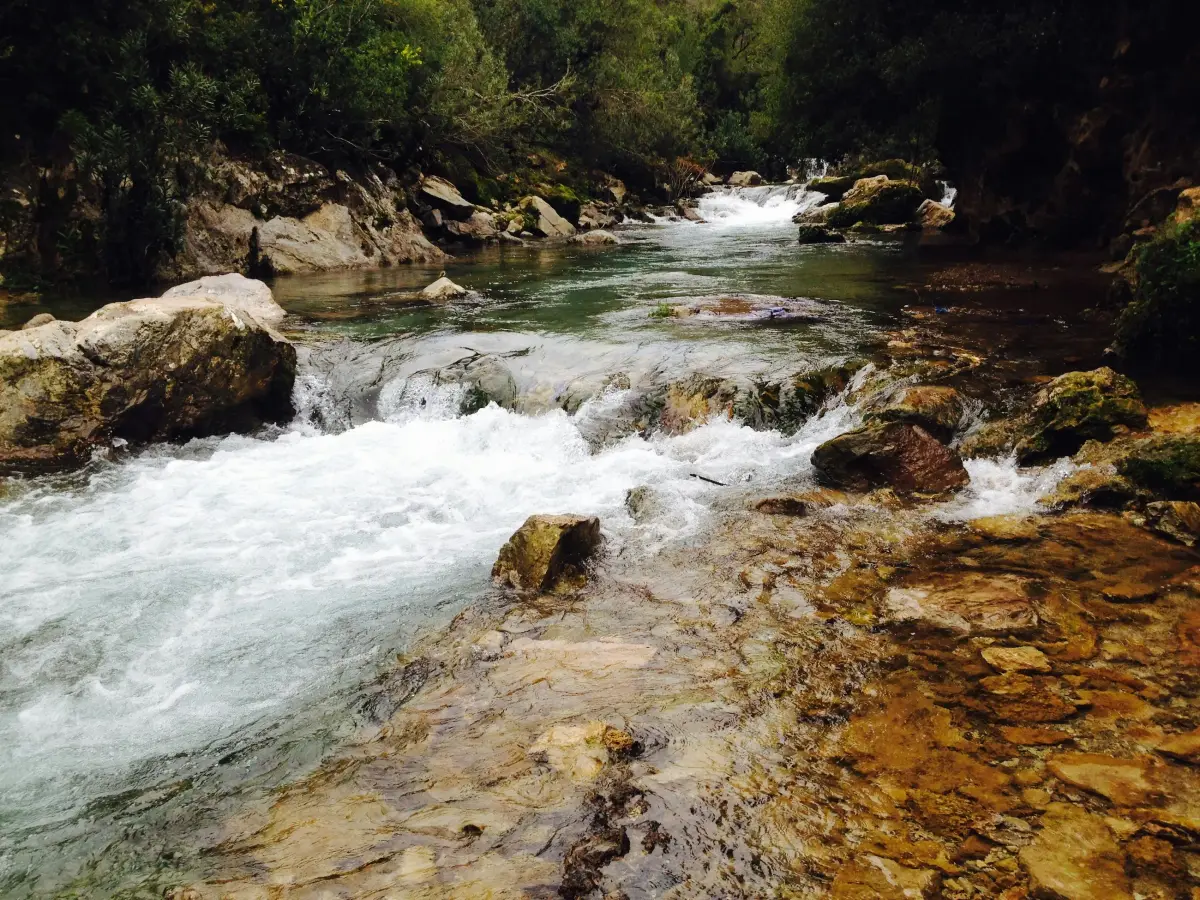
Akchour is a small village and a river gorge in the Rif Mountains, inside Talassemtane National Park. Most people arrive expecting one waterfall and find something closer to a valley walk: a river running over pale limestone, a string of pools and small cascades, a few riverside cafés, and two headline sights at opposite ends of the gorge.
You will see it written several ways. Cascades d'Akchour is the French name and the one Tripadvisor and most signage use; Cascadas de Akchour in Spanish; Akchour Wasserfälle in German; Akchour watervallen in Dutch. It also turns up misspelled as Akshour, Ackhour and Akchor, which is worth knowing when you are searching for it. The name itself is Berber and is usually reported to mean something like "somewhere" or "a part of" — a nod to how far into the mountains it sits, though we have not found an authoritative source for that.
Talassemtane National Park covers 58,950 hectares — about 590 km² — and was established on 8 October 2004. It later became part of the UNESCO Intercontinental Biosphere Reserve of the Mediterranean, and it protects the Moroccan fir, Abies marocana, which grows wild almost nowhere else. Land in the park rises from around 350 m to over 2,100 m. Akchour sits low in that range, which is why the walking is along a river rather than up a mountain.
The bit most guides skip
One car park, one dam, two completely different walks
From the car park you walk about ten minutes upstream to a small concrete dam. This is the decision point, and it is the single most useful thing to understand before you go, because from here the two trails go opposite ways and they are not remotely the same length.
Cross the bridge and take the path on the left of the dam and you are heading up the valley towards the waterfalls — the Petite Cascade first, then the Grande Cascade much further on. Come back to the dam, cross again, and take the right-hand path and you are heading for God's Bridge.
Almost nobody does both properly in one day. Trying to is the usual reason people come back saying Akchour was exhausting or that they never found the waterfall.
The two walks
Which one you have time for
Times below are walking time at an ordinary pace, not counting swimming, lunch or photographs. Nothing at Akchour is officially waymarked with distances, and published figures vary a lot. The distances are ours, measured along the OpenStreetMap footpath network; the times are ranges rather than precise numbers.
God's Bridge (Pont de Dieu)
- Time
- 40 min to 1 hr each way on the upper path
- Distance
- About 1.5 km each way from the dam on the upper path — near enough 4 km round trip from the car park
- Difficulty
- Easy to moderate
What it is
A natural rock arch the river has cut through the cliff, somewhere around 25 to 35 m above the water depending on whose figure you take — none of them are surveyed. It is a geological formation rather than a waterfall, which means it looks the same in August as it does in April. If you are visiting in late summer and want to be sure of seeing something impressive, this is the one to walk.
Watch for
There are two ways to reach it and this is where published times disagree wildly. The upper path is a dirt road and takes most people 40 minutes to an hour each way. The other approach scrambles up the Oued Farda riverbed itself and takes two to four hours, with real river crossings. Guides quoting "3 to 4 hours to God's Bridge" are describing the river route. Ask at the dam which one you are on if you are not sure.
Best for: On the upper path: families with steady walkers, anyone short on time, and anyone visiting between August and October when the big waterfall may be dry. Not the river route, which involves crossings on stepping stones and makeshift log bridges — first-hand accounts of the walk to the arch mention those crossings whichever way they went, so if you are unsure on uneven ground, ask at the dam before you set off.
The waterfalls: Petite then Grande Cascade
- Time
- Petite Cascade 40 min to 1 hr in; Grande Cascade about 1.5–2 hrs each way
- Distance
- Petite Cascade about 1.9 km each way from the dam; Grande Cascade about 5.5 km
- Difficulty
- Easy to the Petite Cascade, moderate to strenuous beyond it
What it is
The path follows the river past pools you can swim in. The Petite Cascade comes up quickly and is a perfectly good turnaround point — plenty of people go no further and have a fine day. Carrying on to the Grande Cascade is a serious walk: budget 4 to 5 hours round trip once you have stopped to look at anything. Its height is usually given as 60 to 100 m and has never, as far as we can tell, been properly measured.
Watch for
Up to the Petite Cascade the path is wide, well-trodden and mostly flat, with cafés along it. Past the Petite Cascade it changes: the path narrows, the crossings on stepping stones, logs and cement blocks come more often, and there are steeper, rockier sections. The limestone is polished and genuinely slippery when wet, so grippy shoes rather than sandals. The gorge is narrow, so avoid the riverside sections during or straight after heavy rain — flash flooding is the real hazard here.
Best for: The Petite Cascade suits almost everyone. The Grande Cascade suits fit walkers in spring, with a full day set aside for it.
Being straight about the timing
What fits inside a 3 to 4 hour wait
Our standard trip has the driver waiting 3 to 4 hours at the trailhead. That is comfortable for God's Bridge by the upper path, or the Petite Cascade, either of them with time left over to swim and eat. It is the right amount of time for most people.
It is not enough for the Grande Cascade. That walk is 4 to 5 hours round trip on its own before you have stopped for anything, so it needs a longer day than the standard wait covers. If that is the walk you want, say so when you message us and we will ask the driver what a longer day costs for your date — we would rather quote it properly than sell you a wait that runs out while you are still two hours up the valley.
The same goes for the river-scramble route to God's Bridge, which runs two to four hours each way rather than the upper path's forty minutes.
When to go
The waterfall is seasonal. The arch is not.
This is the thing worth knowing before you book, and most pages bury it. The Grande Cascade is fed by Rif snowmelt and by a river that also gets drawn off upstream for irrigation, so how much water is falling varies enormously across the year.
- March to May
- The best window. Snowmelt has the river high, the falls are at full flow, and the valley is green. Trails can still be slippery after spring rain.
- June and July
- Warm, busy, and good for swimming in the pools. Water levels are already dropping from the spring peak but the falls are still running.
- August to October
- The honest caveat. Flow drops sharply and in many years the big waterfall is reduced to a trickle — visitors report finding it all but dry. The pools and the river walk are still pleasant, and God's Bridge is unaffected because it is rock. If you are coming in this window, plan for God's Bridge and treat any water as a bonus.
- November to February
- Quiet, cool, and the river refills. The catch is rain: limestone gets slippery, and the narrow gorge sections carry a flash-flood risk during and just after heavy weather. Check the forecast and skip the riverbed routes if it has been wet.
Getting there
Shared taxi, private taxi, or a driver who waits
Akchour is about 30 km from Chefchaouen on the P4105, a winding mountain road that takes 40 to 45 minutes. There are three normal ways to do it and the cheapest one is fine for a lot of people.
Shared grand taxi
About 25 MAD per seat, each way
They leave from the Akchour stand in Chefchaouen when they are full, which can mean a wait. This is the budget option and there is nothing wrong with it. The thing to plan around is the return: the last shared taxis back generally go between about 17:00 and 18:00, and if you miss them you are negotiating in the dark.
Private grand taxi
Roughly 200–400 MAD depending on waiting time and haggling
You are hiring the whole car. Quotes vary a lot — we have seen 150 MAD each way at one end and 400 MAD round trip at the other, for the same journey. It is negotiable, it is cash, and what you actually pay depends on how long you keep the driver waiting and how well the conversation goes.
Our private day trip
€55 for up to 4, €75 for up to 7 — per vehicle
Hotel or riad door to the trailhead and back, at a price fixed before you get in, with the driver waiting 3 to 4 hours so there is no last-taxi deadline. It is the most expensive of the three and it buys you no haggling, no waiting for the car to fill, and a guaranteed ride home. For a family or a group of four it works out close to the private taxi anyway.
If you are driving yourself
There is a car park at the trailhead. Expect around 10 to 20 MAD for the day, collected by an attendant — reports vary, and some visitors describe being asked again on the way out. The road is paved but narrow and winding, with drops and no barriers in places.
Pricing
Fixed prices, per vehicle
No per-person fares, no surge pricing. Bigger vehicle for bigger groups. We'll say so on WhatsApp before you confirm.
| Route | EUR |
|---|---|
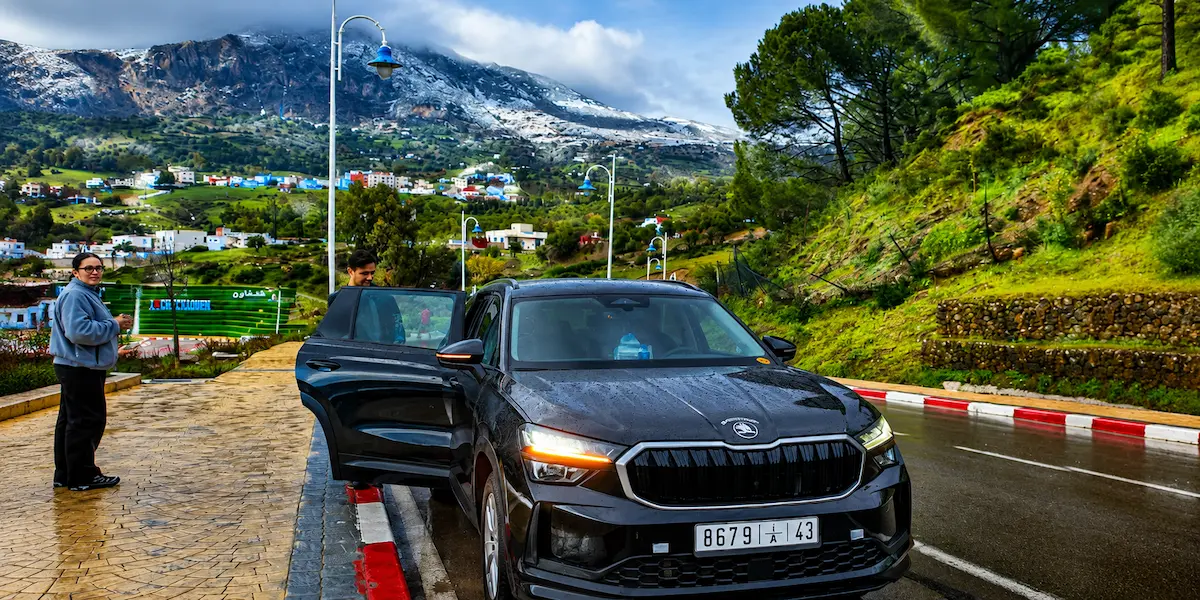
 Skoda (up to 4 passengers) Comfort SUV Three sit in the back row: comfortable for two adults and a child, a bit tight for three adults. | €55 |
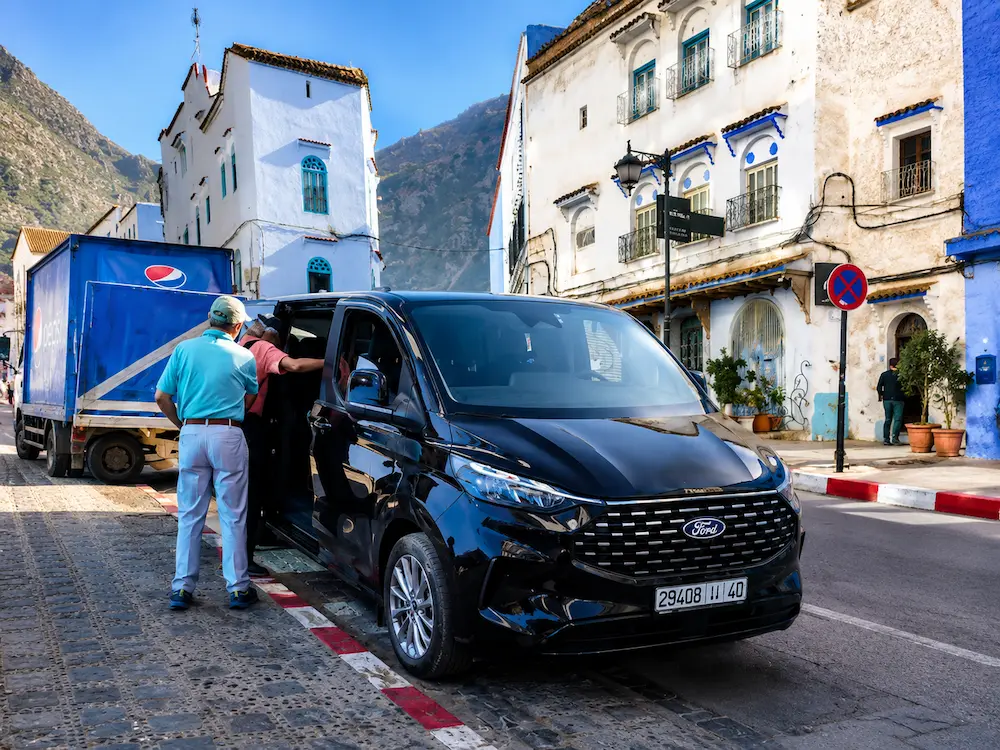
 Van (up to 7 passengers) Spacious 7-seater | €75 |
Fixed rate per vehicle, cash to the driver on the day. Includes the drive out, 3 to 4 hours of waiting at the trailhead, and the drive back. Ask us if you want a longer day for the Grande Cascade.
How it works
Three messages and you're sorted
- 1
Tell us the date and the walk
Message us with your date, how many of you there are, and whether you are aiming for God's Bridge, the Petite Cascade, or the full Grande Cascade. That last one needs a longer day, so it changes the quote.
- 2
We check the date and the vehicle
You get the vehicle, the pickup time and the final fare in one reply. Nothing to pay up front.
- 3
Pickup in Chefchaouen
Your driver collects you from your hotel or riad and drives the 45 minutes out to the trailhead. Start early in summer — the valley is much better before the heat and the crowds.
- 4
Walk, then home
The driver waits at the trailhead while you walk, then takes you back to your accommodation. Pay cash on return, in euros or dirhams.
Before you go
What to bring
There is no shop at the trailhead beyond the cafés, and no ATM anywhere at Akchour. Bring cash.
- Shoes with grip. The limestone is polished and slippery wherever it is wet, and both trails involve river crossings on stones and logs.
- One to two litres of water per person. You can buy drinks at the riverside cafés low down, but not once you are up the valley.
- Cash in small notes, for parking, food, and a guide if you decide you want one.
- Swimsuit and a towel in summer. The pools are swimmable and the water is cold all year.
- Sun cover. Parts of the valley are shaded but the open sections are exposed.
- A packed lunch if you are walking to the Grande Cascade, since the cafés are all near the bottom.
Practical notes
The things people ask at the trailhead
There is no entrance fee
Not for Akchour and not for Talassemtane National Park. There is no gate and no ticket. If someone tells you there is an admission charge, there isn't.
A guide is optional, and there will be pressure
The main trails are well walked and easy to follow, and most visitors do them alone. Local men do offer their services at the trailhead and some are persistent about it, occasionally implying you are required to take one. You are not. If you do want one — and for the river route to God's Bridge it is a reasonable idea — expect somewhere around 100 to 250 MAD for the group, agreed before you set off.
Food along the river
Simple riverside cafés on the lower stretch serve tagine, omelettes and mint tea, mostly on platforms over the water. They are seasonal and busiest at weekends.
Barbary macaques
Akchour sits in the range of the Barbary macaque, the only wild monkey in North Africa. The troops here are shier than the heavily fed ones at Ouzoud, so sightings are luck rather than a guarantee. Do not feed them.
Camping
There are basic campsites near the trailhead, including Camping Akchour and an eco-camp. Reports put a pitch at roughly 30 to 50 MAD for a van and around 80 MAD for your own tent. Facilities are minimal and reviews are mixed, so look before you commit.
Take your rubbish out
Litter along the trail is a genuine and often-mentioned problem here. Carry a bag out with you.
Questions
Frequently asked
Don't see it? Just ask on WhatsApp.
How far is Akchour from Chefchaouen?
Is there an entrance fee for Akchour?
Do I need a guide at Akchour?
Will the waterfall be dry when I visit?
Can I do both God's Bridge and the Grande Cascade in one day?
How long does the driver wait?
Is Akchour suitable for children?
Can you swim at Akchour?
How much is a taxi from Chefchaouen to Akchour?
Is there parking at Akchour?
What is the road to Akchour like?
Do I need to book in advance?
Can you pick us up in Tangier or Tetouan instead?
Which vehicle should I choose?
You might also like
Continue your trip
- TransferTangier to ChefchaouenFrom €80 · 2 hr through the RifSee details →
- Day TripChefchaouen Day Trip from TangierFrom €120 per car · round trip, driver waits ~5 hrSee details →
- GuideBus, Taxi or Private Car to Chefchaouen?Free guide · CTM fares, grand taxi rules and driving, compared honestlySee details →
Ready when you are
Ready to visit Akchour?
Send us your date, your group size, and which walk you have in mind. One reply comes back with the driver, the vehicle and the fixed price.
Answered 8am–11pm, seven days a week